Join Our Journal

.svg)



Inside the $600 Million Airbus A380 That Has a Concert Hall, a Stable for Camels and a Rolls-Royce Garage
It has a concert hall with a baby grand piano, a Turkish bath with gold-plated fittings, a prayer room whose mats rotate automatically to face Mecca, a built-in garage for a diamond-encrusted Rolls-Royce, and a stable for horses and camels. At $600 million, the Airbus A380 Flying Palace is the most extraordinary private jet ever built and the story behind it is unlike anything else in the world of ultra-luxury travel.
There is a moment, when you first encounter the full specification of this aircraft, when the mind simply stops processing.
Not because of the price though $600 million is a figure that defies ordinary comprehension. Not because of the size though the Airbus A380 is the largest passenger aircraft ever built, a machine capable of carrying 853 people across continents without refuelling. The moment of genuine cognitive arrest comes later, when you reach the details. When you learn that this particular A380 has a stable for horses and camels. A concert hall with a baby grand piano. A prayer room whose mats rotate automatically to face Mecca. A garage inside a flying aircraft large enough to house a diamond-encrusted Rolls-Royce.
At that point, the mind stops not because of excess, but because of vision. Because someone looked at the world's largest commercial airliner and thought: this is the beginning. And then they built something that has not been equalled, before or since.
This is the story of the most extraordinary private jet ever conceived and the world it was designed to carry.
The Man Behind the Flying Palace
To understand the aircraft, you have to understand the man who commissioned it.
Prince Alwaleed bin Talal bin Abdulaziz al Saud is not simply a wealthy member of the Saudi royal family. He is, by any serious measure, one of the most significant investors of the last half century a man who made early, contrarian bets on Citigroup, Apple, and Newscorp that made him a legend in global finance before many of his contemporaries had understood what was happening. At his peak, Forbes ranked him among the 13 wealthiest individuals on earth, with a net worth exceeding $30 billion.
He is also, by any measure, a man of extraordinary taste and ambition when it comes to the objects that surround him. His megayacht Kingdom 5KR, formerly known as Nabila is itself one of the most celebrated private vessels in the world, a 147-metre ship that was previously owned by Adnan Khashoggi and appeared in the James Bond film Never Say Never Again. His private fleet already included a Boeing 747 converted for personal use, an Airbus A321, and a Hawker Siddeley 125, before the A380 was even conceived.
In October 2007, attending the Dubai Airshow, Prince Alwaleed saw an Airbus A380 on display for the first time. He made his decision almost immediately. He would commission the world's first private A380 not simply as a mode of transport, but as the most extraordinary private environment ever built in the sky.
The aircraft was christened, without irony, the Flying Palace.

The Commission: No Budget, No Ceiling
The commission was given to two design firms working in collaboration: Edese Doret Industrial Design, the American studio that would define the interior language of the aircraft, and Design Q, who contributed to the technical realisation of the project. The brief, as far as anyone outside the project has been able to determine, had no upper limit on ambition.
What emerged from that brief was a specification unlike anything the aviation world had ever seen a private aircraft conceived not around the constraints of what was possible in a flying vehicle, but around the life its owner intended to live inside it.
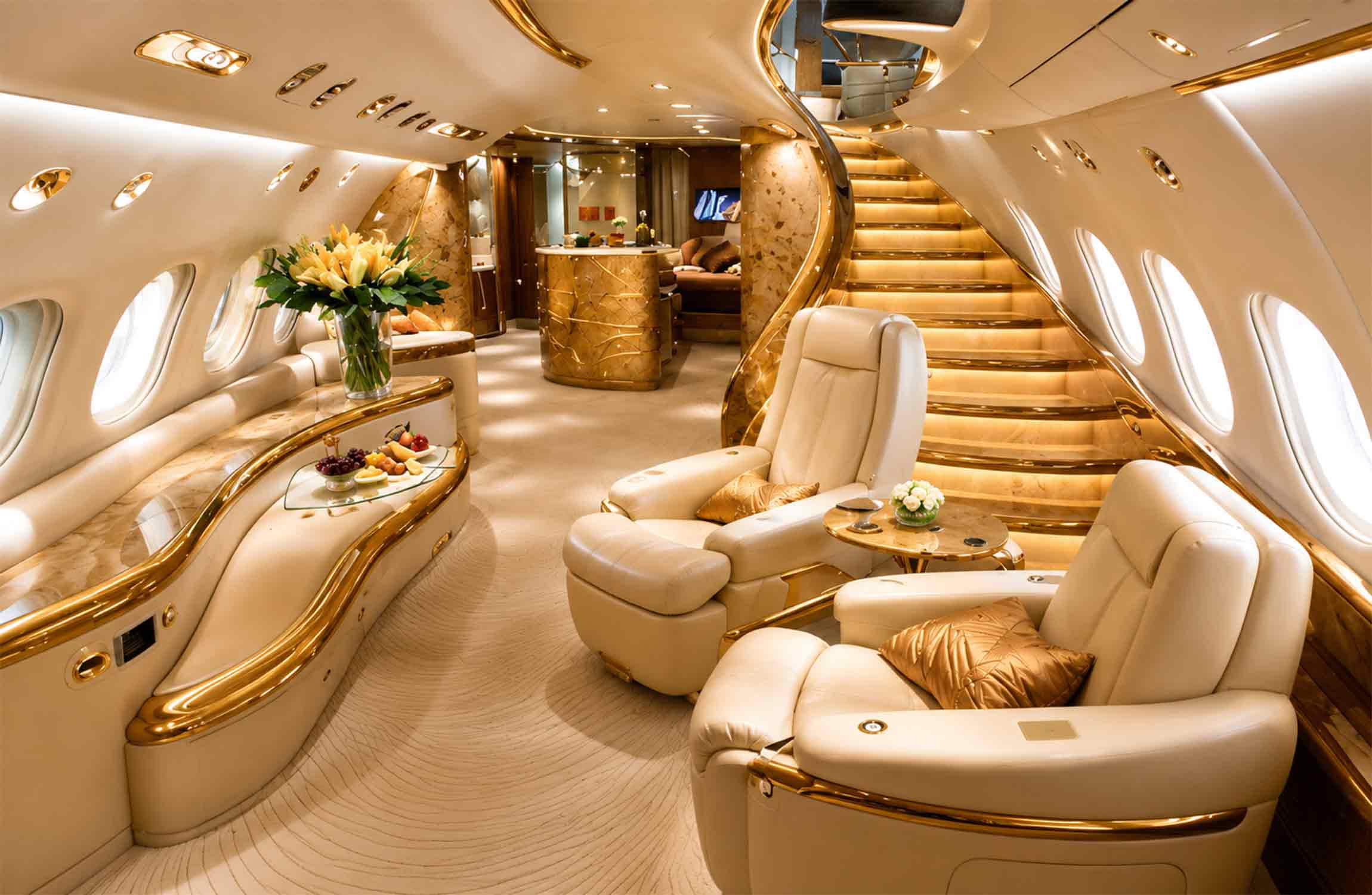
The A380 presented a canvas that no other aircraft could offer. At 550 square metres of usable interior space spread across three separate levels, connected by private glass elevators, the aircraft was closer in scale to a luxury townhouse than to any conventional private jet. The ceilings were high enough to stand without compromise. The corridors wide enough to pass without turning sideways. For the first time in the history of private aviation, a designer could think not in terms of a cabin, but in terms of rooms. And that is precisely how Edese Doret approached it.
The Interior: Floor by Floor
The Private Suites
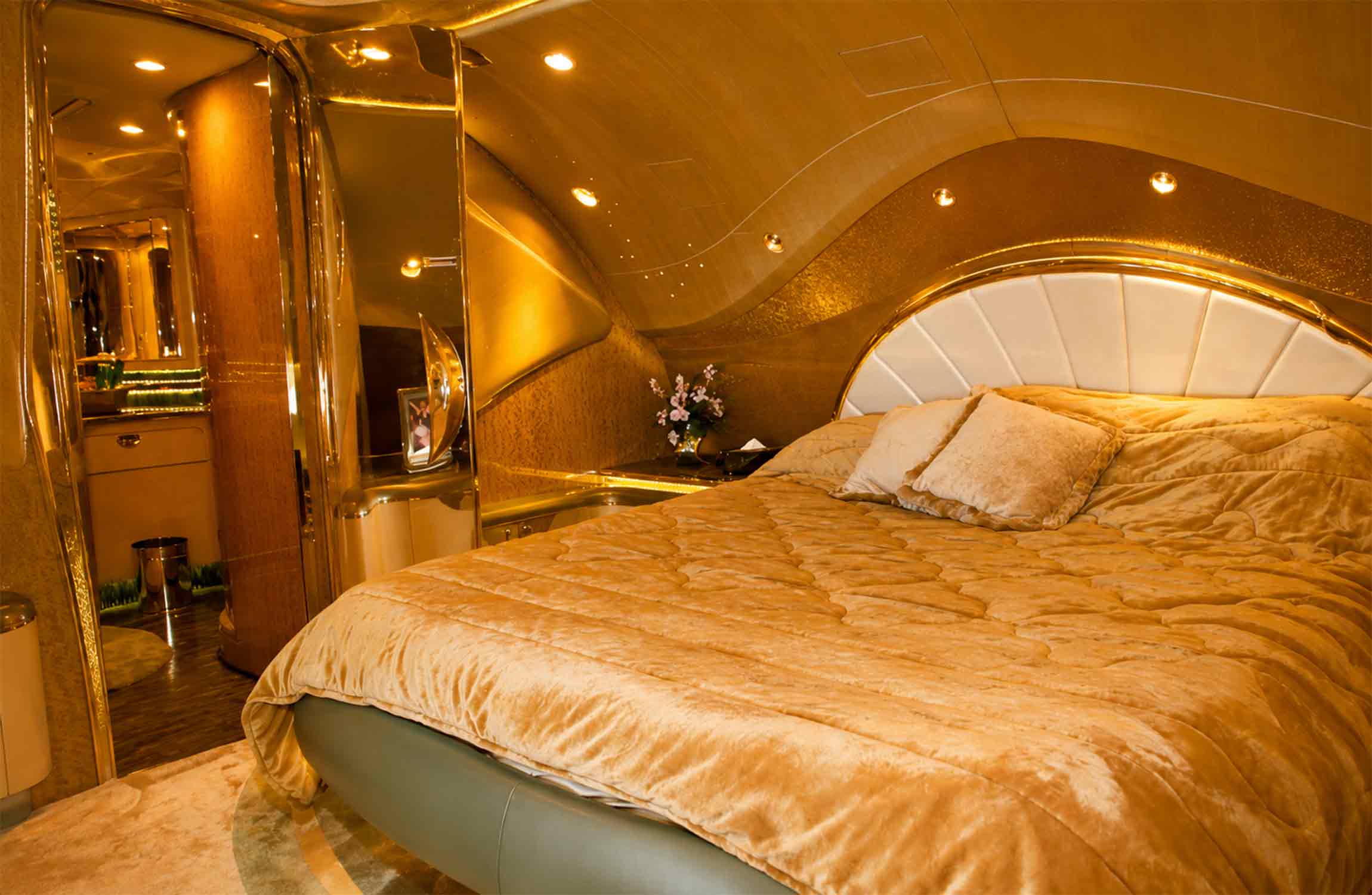
At the heart of the aircraft the spaces that would define the experience of living on board were five private bedrooms, each configured with a king-sized bed, its own relaxation and dining area, and a full en suite bathroom with shower. Not a compact aircraft bathroom. A genuine, full-size shower room, with the materials and finish of a five-star hotel suite.
For guests accustomed to the finest hotels in the world the kind of suites found at the most extraordinary private addresses on the French Riviera the bedroom suites of the Flying Palace were designed to feel not like an aircraft cabin upgraded to luxury, but like a private residence that happened to be airborne.
The distinction matters. There is a fundamental difference between luxury that has been added to a utilitarian space and luxury that has been conceived from the beginning as the only possible intention. On the Flying Palace, every dimension, every material, every decision was made in service of the latter.
The Concert Hall
Of all the spaces in the Flying Palace, none has captured the imagination of aviation writers, collectors, and the luxury world quite like the concert hall.
Seating ten passengers, the concert hall was designed around a baby grand piano an instrument placed inside a flying aircraft with the same seriousness of purpose that would accompany its installation in a private salon in Paris or a residence on the French Riviera. The room featured bar stools along its perimeter, allowing the space to function as both a formal concert setting and a more casual gathering place for drinks and conversation.
For a man of Prince Alwaleed's cultural interests and social world, the concert hall was not an eccentricity. It was a statement of values an insistence that the highest form of human expression should travel with him, regardless of altitude.
The Boardroom and Dining Room
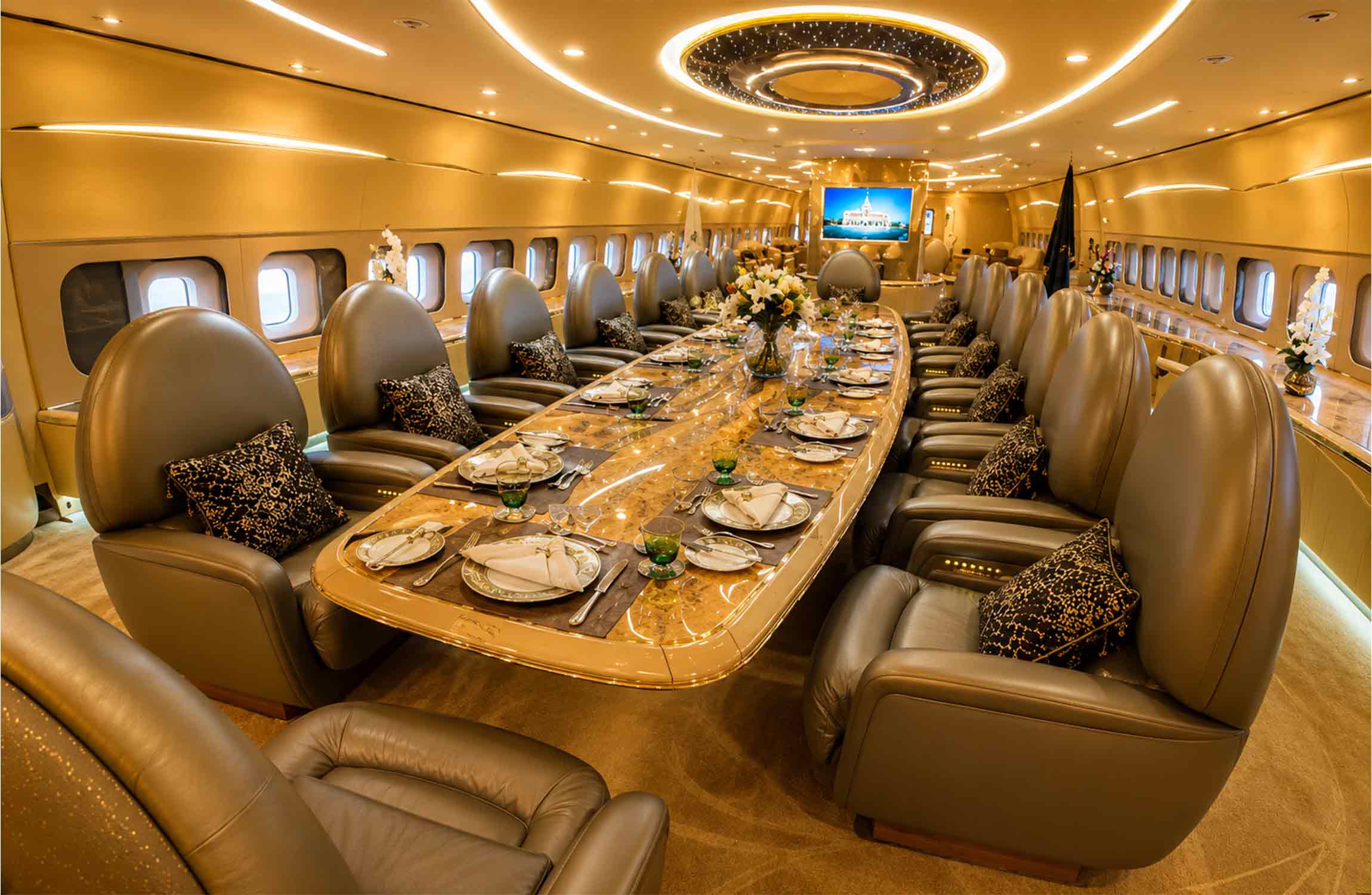
The Flying Palace was not designed solely for pleasure. It was designed for power for a man who moved between continents conducting one of the most significant investment operations in the world, and who needed his aircraft to function as a mobile headquarters of the highest order.
The boardroom featured a holographic projector a technology that, at the time of the commission, was at the absolute frontier of corporate presentation tools positioned within a room designed for serious decision-making at altitude. Background monitors displayed maps with Arabic script, with Dubai as the reference destination: a detail that revealed, quietly, how the Prince intended to use this space.
The formal dining room seated fourteen guests at a single table a configuration more commonly found in the private dining rooms of historic European estates than in any aircraft. Every seat featured extendable footrests, massage facilities, and adjustable lumbar support: the logic of a business-class seat applied to a formal dining chair, in a room where the business being conducted could move markets.
The Turkish Bath
Perhaps the most discussed amenity on the Flying Palace after the camel stable is the Turkish bath.
A full-size steamroom, finished with gold-plated fittings, occupying a dedicated space on one of the aircraft's three levels. The Turkish bath, or hammam, is a tradition with deep cultural roots in the world Prince Alwaleed inhabits a space of purification, relaxation, and social ritual that has existed at the centre of Arab and Ottoman luxury for centuries. To commission one inside a private aircraft was to insist that even at 45,000 feet, the rhythms and rituals of a particular way of life would remain intact.
The gold-plated fittings were not ostentation for its own sake. They were the natural material language of a space designed to honour a tradition the same philosophy that drives the finest examples of craftsmanship in any collecting category, from the Steinway pianos that become multi-million-dollar works of art to the hammam on board the Flying Palace.
The Prayer Room
The prayer room on the Flying Palace is the detail that reveals, more than any other, the depth of thought behind the aircraft's design.
A private, dedicated space for prayer is not unusual in the residences and properties of observant Muslims of Prince Alwaleed's background. What is extraordinary is the engineering required to make such a room function correctly inside a moving aircraft. The prayer mats in the Flying Palace rotate automatically, continuously recalculating their orientation to ensure they always face Mecca — regardless of the aircraft's heading, altitude, or position over the earth.
It is, in its way, one of the most technically precise details in the entire aircraft: a system designed not for display, but for genuine devotional use, embedded inside the most expensive private jet ever built.

The Garage
And then there is the garage.
Inside the Flying Palace, occupying a dedicated space in the lower section of the aircraft, is a built-in automobile garage large enough to house a Rolls-Royce. Not any Rolls-Royce: Prince Alwaleed's diamond-encrusted Rolls-Royce, an automobile that is itself a significant object of value and craftsmanship, travelling alongside its owner in a purpose-built space as naturally as luggage in a hold.
The concept of bringing an automobile aboard a private aircraft belongs to a category of luxury that most people never encounter even in imagination the category where the constraint of choosing between things simply does not apply. The Flying Palace was designed for someone for whom the question was never "which of these" but always "all of these, together, exactly as I intend."
The Stable
The stable for horses and camels along with a pen for hawks represents the final expression of that same logic.
For a Saudi prince of Alwaleed's generation and background, the keeping of horses, camels, and falconry birds is not an affectation. It is a deeply rooted cultural practice, a connection to the traditions of the Arabian Peninsula that persists regardless of the international character of a billionaire's life. The stable on the Flying Palace was not a novelty. It was a necessity a recognition that the life Prince Alwaleed intended to live, fully and without compromise, required that these companions travel with him.
It is, perhaps, the detail that best illustrates the fundamental philosophy of the Flying Palace: that the function of this aircraft was not to transport its owner from place to place, but to ensure that his world every element of it could travel with him intact.
The Twist: A Palace That Never Flew
Here is where the story takes a turn that even its most dramatic details had not prepared the aviation world for.
After years of design work, engineering consultations, and the development of a specification that had never been attempted before, Prince Alwaleed sold the Flying Palace to an anonymous buyer before he ever took delivery of it. He never flew in the aircraft he had commissioned. The reasons were never officially disclosed.
The anonymous buyer who acquired the A380 paid $400 million for the aircraft as configured, then invested an additional $200 million in further interior modifications under the continued direction of Edese Doret bringing the total investment to approximately $600 million, and producing the final version of the Flying Palace as it exists today.
It is owned by someone whose identity remains, to this day, unknown. Which is, in its own way, the most fitting conclusion to the story of an aircraft conceived around the deepest possible commitment to privacy.
What the Flying Palace Tells Us About Luxury at Its Limit
There are objects in the world that exist at the absolute boundary of what human ambition and resources can produce. The Steinway Alma-Tadema piano. The most extraordinary private estates. The superyachts that transform Monaco's port each summer into something that defies ordinary visual categories.
The Flying Palace belongs in that conversation not because of its price, though $600 million is a figure without precedent in private aviation, but because of what it represents: a total, uncompromising vision of how a particular life should be lived, translated into a physical environment with no concession to limitation.
A concert hall. A Turkish bath. A prayer room that finds Mecca from any point on earth. A garage for a diamond Rolls-Royce. A stable for camels. Five bedrooms. Fourteen seats at dinner. A boardroom with a holographic projector.
This is not excess. It is completeness the attempt to build, inside the world's largest aircraft, a world as fully realized as the one outside it.
Whether the unnamed owner who flies in it today feels that ambition was achieved is a question that will, in all likelihood, never be answered. What is certain is that nothing quite like it has been built before, and given that Airbus ceased production of the A380 in 2021, nothing quite like it will be built again.
The Flying Palace is, in every sense, one of a kind.
Image
Gallery.


Explore
Related posts.

Get
Inspiration
@luxurymedia