
Join Our Journal

.svg)


The Steinway Masterpieces That Became Multi-Million-Dollar Works of Art
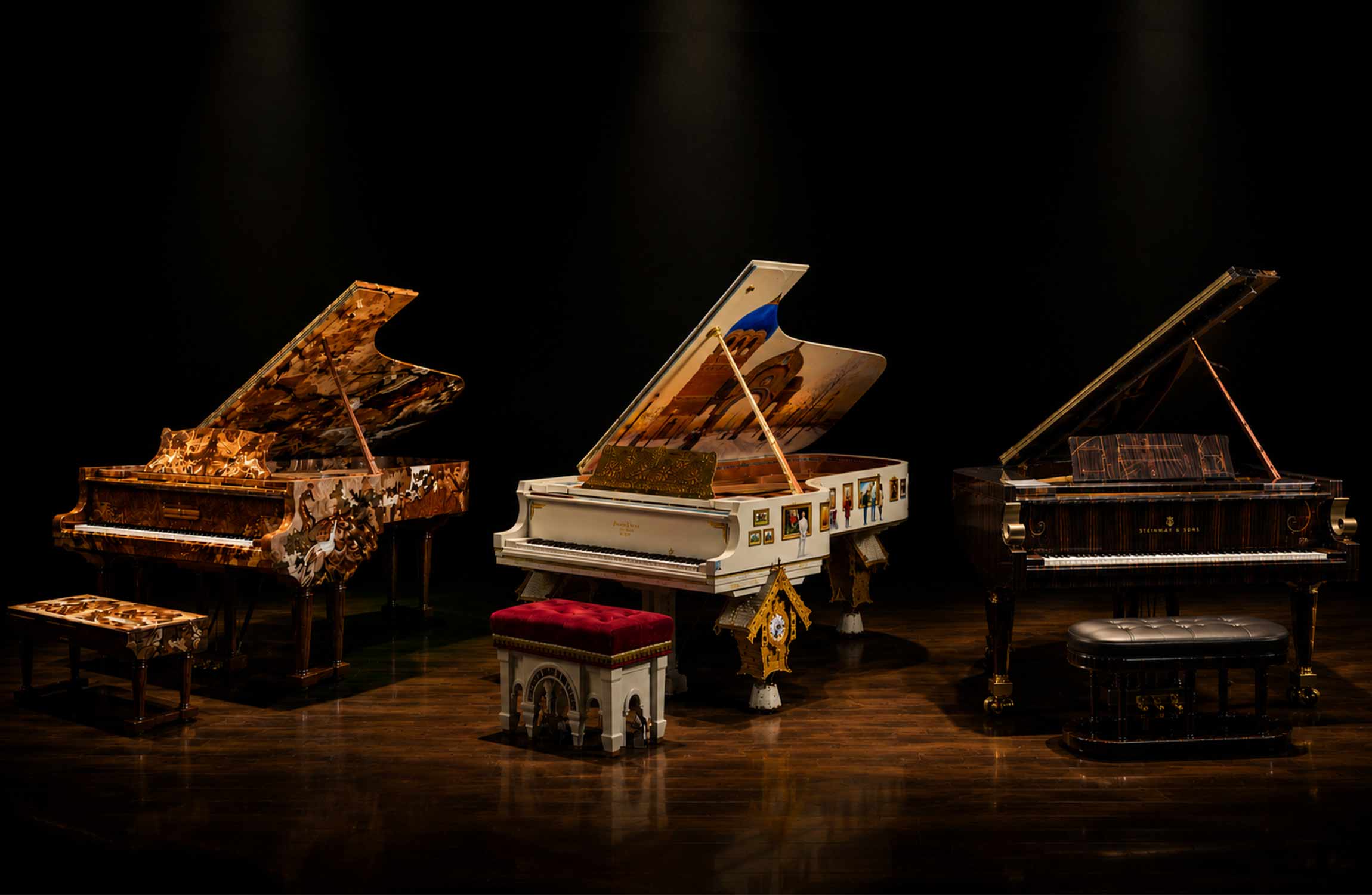
A Patek Philippe is no longer simply a watch. A Ferrari 250 GTO is no longer merely a car. And these three Steinway pianos the Alma-Tadema, the Pictures at an Exhibition, and the Fibonacci are no longer simply instruments. They are among the most extraordinary objects ever created, and the stories behind them are unlike anything else in the world of luxury collecting.
Not the obvious ones the address, the square footage, the view. The objects that reveal the person behind the property. The Patek Philippe on the desk. The Ferrari 250 GTO in the garage. The painting that was acquired not because it matched the room, but because it could not be left in someone else's hands.
In the world's finest private residences the kind of homes that take three and a half hours to tour and still leave visitors feeling they've barely scratched the surface there is often one object that commands the room more completely than any other. Not because of what it costs. Because of what it represents.
For a small number of collectors, that object is a piano. Not any piano. A Steinway that transcends the instrument entirely and becomes something closer to a monument a testament to what human hands can achieve when time, skill, and vision are given without limit.
Three of those instruments stand above the rest.
The Steinway Alma-Tadema The Grandest Grand Piano Ever Created
In 1883, a railroad and insurance tycoon named Henry Gurdon Marquand one of the founders of the Metropolitan Museum of Art in New York commissioned the most celebrated Victorian painter of his era to design a music room for his Manhattan mansion. He gave the artist, Sir Lawrence Alma-Tadema, unlimited funds and no budget constraint. None.
The result was a room that became one of the most extraordinary domestic spaces of the 19th century. And at its centre, its absolute centrepiece, was a Steinway Model D concert grand piano that has been called, without serious dispute, the grandest grand piano of all time.
The instrument serial number 54538 was built between 1883 and 1887. The exterior is adorned with over 2,000 individual pieces of mother-of-pearl inlaid into the hand-carved case. The fallboard features a painting by Sir Edward Poynter entitled The Wandering Minstrels a group of girls dancing to musicians executed with the same precision as a museum canvas. The names of Apollo and the nine Muses are inlaid across the lid. Inside the piano, several parchment sheets carry the signatures of musicians who played it during its first years of existence.
Alma-Tadema collaborated with the London furniture designers Johnstone, Norman and Co. on every detail of the case, treating the instrument not as a piano but as the defining piece of furniture in a room conceived as a total work of art.
The Alma-Tadema passed through auction several times over the following century selling for $360,000 in 1980, then appearing at Christie's London in 1997, where it established what was then the greatest price ever paid for an art-case piano: $1.2 million. A century-old instrument, in a room at Christie's, outperforming the market for contemporary luxury goods.
The recreation commissioned by Steinway in 2002 which took more than 20 months to complete and sold for $675,000 to a museum in Tallahassee, Florida is itself a testament to the impossibility of improving on what Alma-Tadema created in 1883.
Some things can only be made once.

The Steinway Pictures at an Exhibition Four Years. One Canvas. $2.5 Million.
There is a particular kind of ambition that refuses to separate music from art that insists the instrument itself must be worthy of the sound it produces. The Steinway Pictures at an Exhibition is the most complete expression of that philosophy ever created.
Conceived as a tribute to Modest Mussorgsky's celebrated orchestral suite itself a musical interpretation of paintings by the artist Viktor Hartmann the piano was designed, painted, and brought to life by Steinway master craftsman Paul Wyse over a period of four years. It was the first Steinway art instrument ever inspired directly by a musical composition, and it remains the most visually complex piano the company has ever produced.
Every panel of the exterior carries elaborate marquetry drawn from scenes within Mussorgsky's suite. The level of detail is, by any measure, extraordinary thousands of hours of precision work, each wood inlay chosen and placed with an accuracy that no photograph has ever fully captured. Viewed in person, the panels create depth, movement, and texture that shift depending on the angle of light and the position of the observer. The instrument does not simply sit in a room. It inhabits it.
Its estimated value of $2.5 million places it among the most expensive pianos ever created. But for collectors who understand that the rarest objects carry a value independent of any market that certain things cannot be replaced at any price the Pictures at an Exhibition occupies a category beyond valuation.
It is the kind of acquisition made not because the price is right, but because the alternative is allowing it to belong to someone else.

The Steinway Fibonacci 6,000 Hours. One Vision. $2.4 Million.
Not all extraordinary Steinway masterpieces look backwards. The Fibonacci commissioned to mark the production of the 600,000th piano in Steinway history looks forward with a clarity and confidence that has made it one of the most admired modern piano designs ever created.
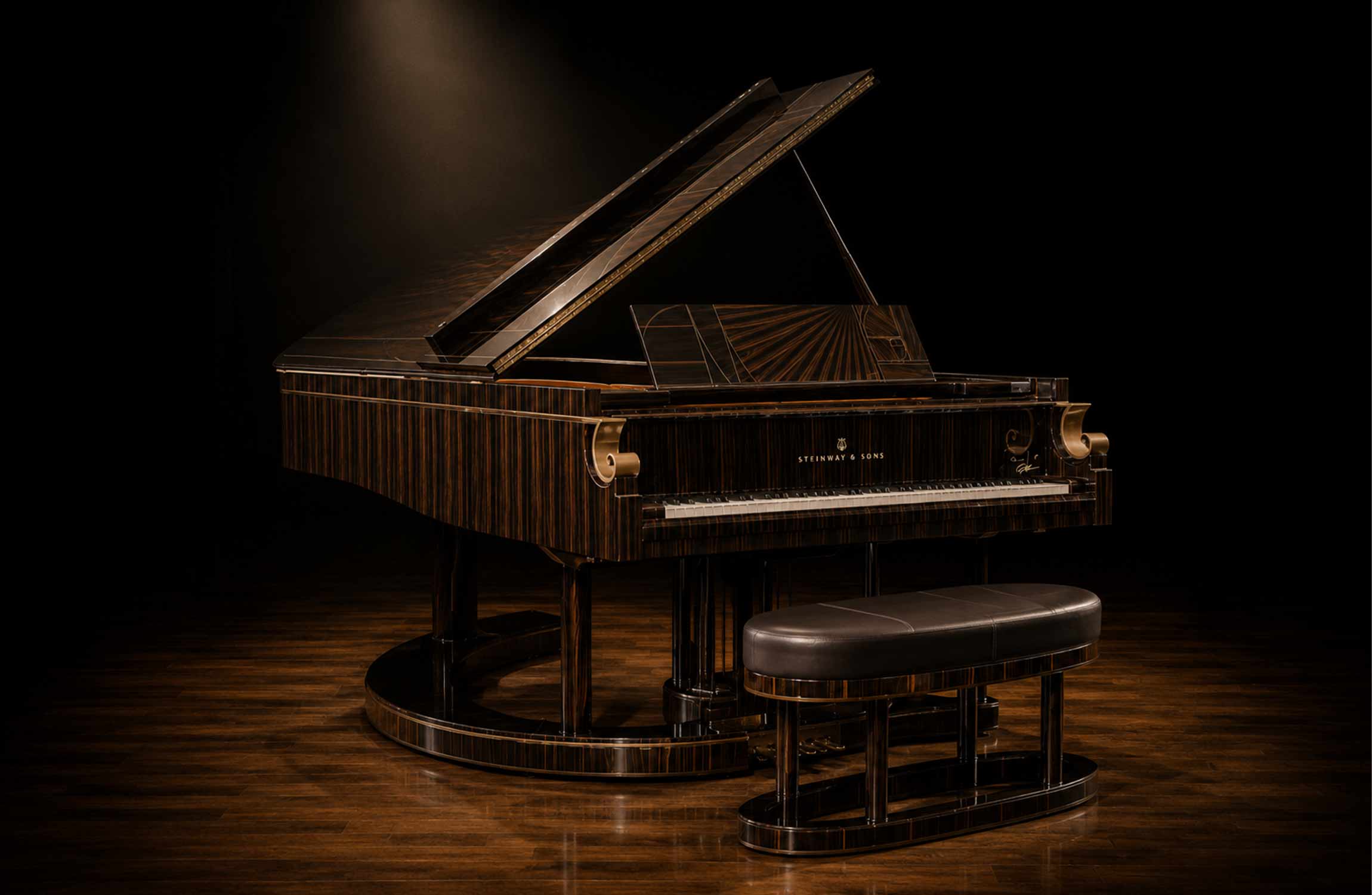
Designed by the renowned American furniture designer Frank Pollaro, the Fibonacci draws its entire visual language from mathematics: specifically, from the Fibonacci sequence and the golden ratio, the proportional system that has underpinned architecture, art, and design from ancient Greece through the Renaissance and into the present day. The exterior features a flowing spiral crafted from rare Macassar ebony a material of extraordinary visual depth that creates a sense of movement across the entire surface of the instrument. The piano appears, even when completely still, to be in motion.
The construction required more than 6,000 hours of work. Every curve was shaped by hand. Every surface was finished to a standard that makes the Fibonacci as much a sculptural object as a musical instrument.
Valued at approximately $2.4 million, it represents what happens when a designer of genuine vision is given both the freedom and the resources to pursue a single idea to its absolute conclusion the same philosophy behind the ultra-rare collector pieces that define the pinnacle of any category, whether that category is whisky, art, or a 600,000th piano.
For the private residence with the space and the eye to receive it, the Fibonacci is not a piano. It is a statement about the kind of beauty that only emerges when craftsmanship is allowed to become art.
What These Three Instruments Reveal About Collecting at the Highest Level
There is a truth that serious collectors understand, and that the Alma-Tadema, the Pictures at an Exhibition, and the Fibonacci each demonstrate in their own way.
The most valuable objects are not the most expensive ones. They are the ones that could not exist without the specific vision, skill, and commitment of the people who made them. They are the ones that carry, inside themselves, an irreplaceable quantity of human time and human thought the hours of Paul Wyse working on a panel that no camera would ever adequately capture, the months of Frank Pollaro shaping a spiral from Macassar ebony, the three years of craftsmen in 1883 placing 2,000 pieces of mother-of-pearl into a case that would outlast everything around it.
A Patek Philippe is irreplaceable because no other watchmaker has spent 180 years refining the same mechanisms. A Steinway art-case piano is irreplaceable for the same reason: because the people who built it will never exist again, in those conditions, with those materials, making that particular decision at that particular moment.
When a collector acquires one of these instruments, they are not acquiring a piano. They are acquiring the evidence that something extraordinary once happened and ensuring that it will not be forgotten.
Image
Gallery.


Explore
Related posts.

Get
Inspiration
@luxurymedia